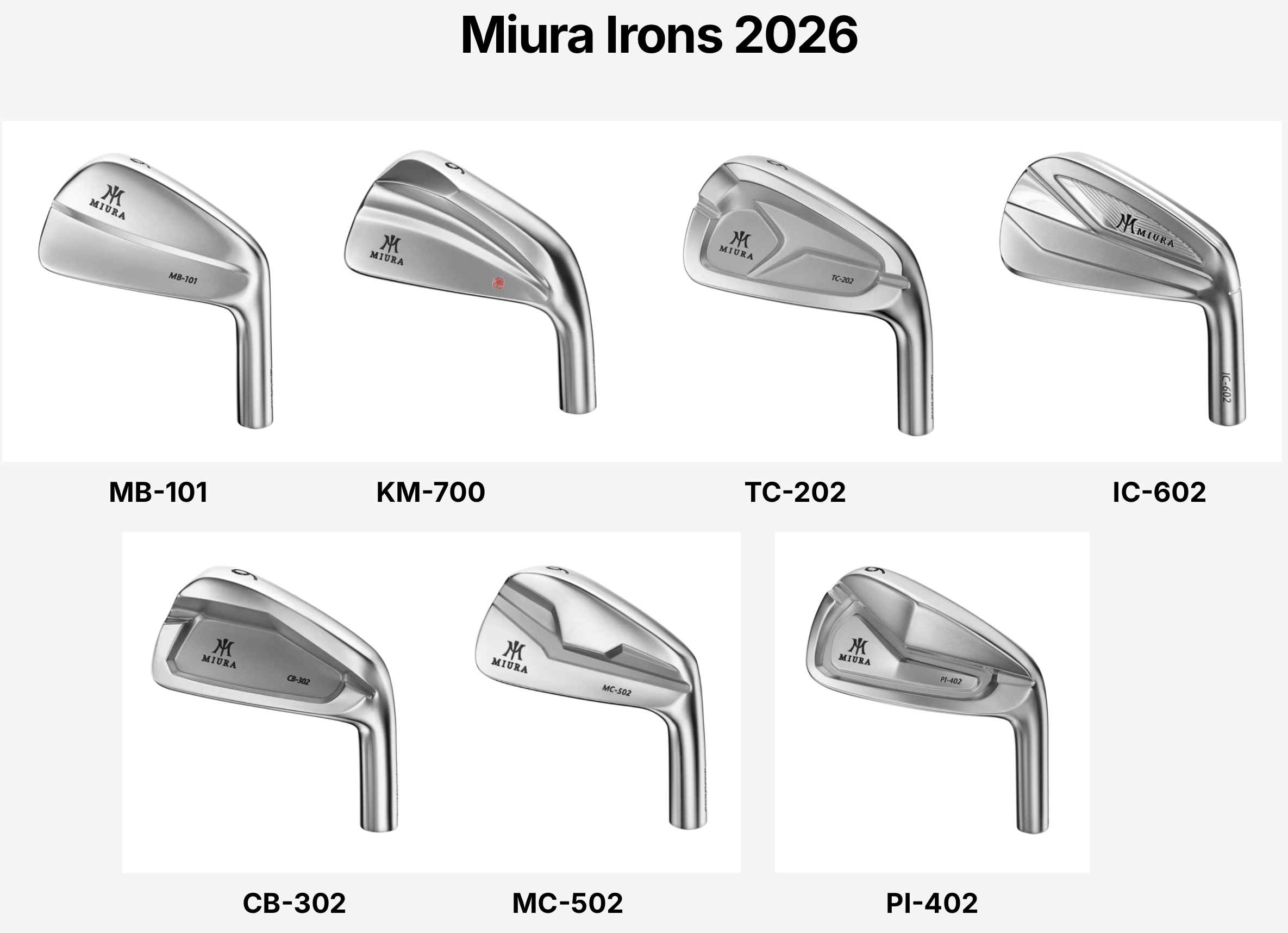
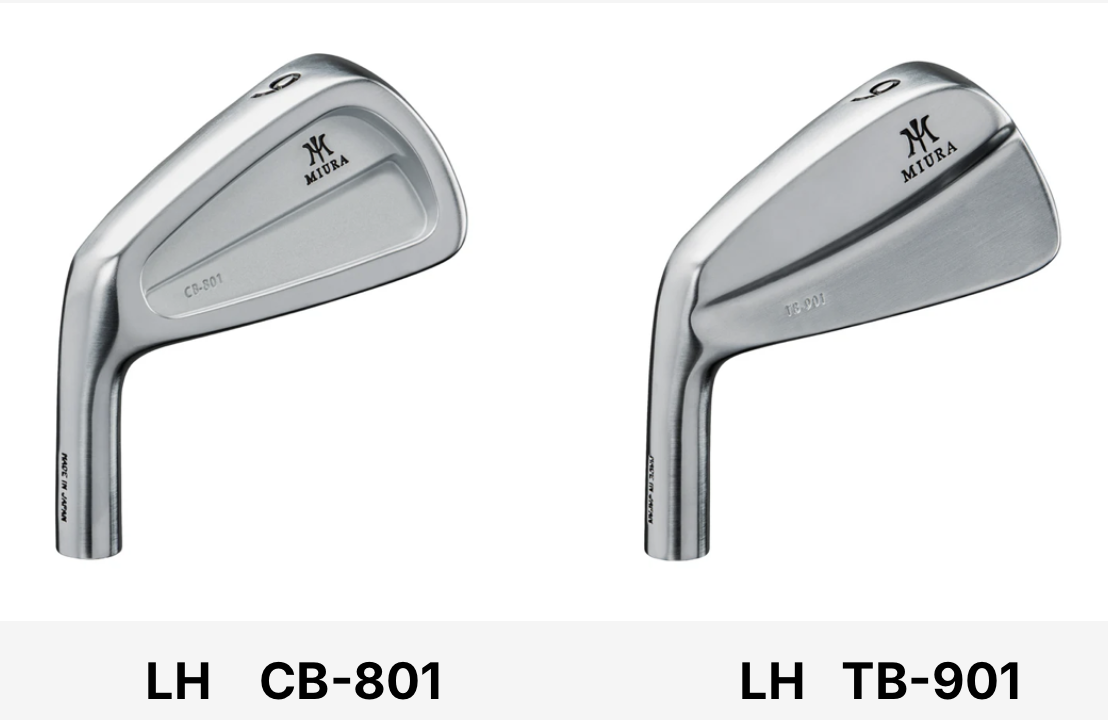
Specifications for 2026 Production Miura Irons
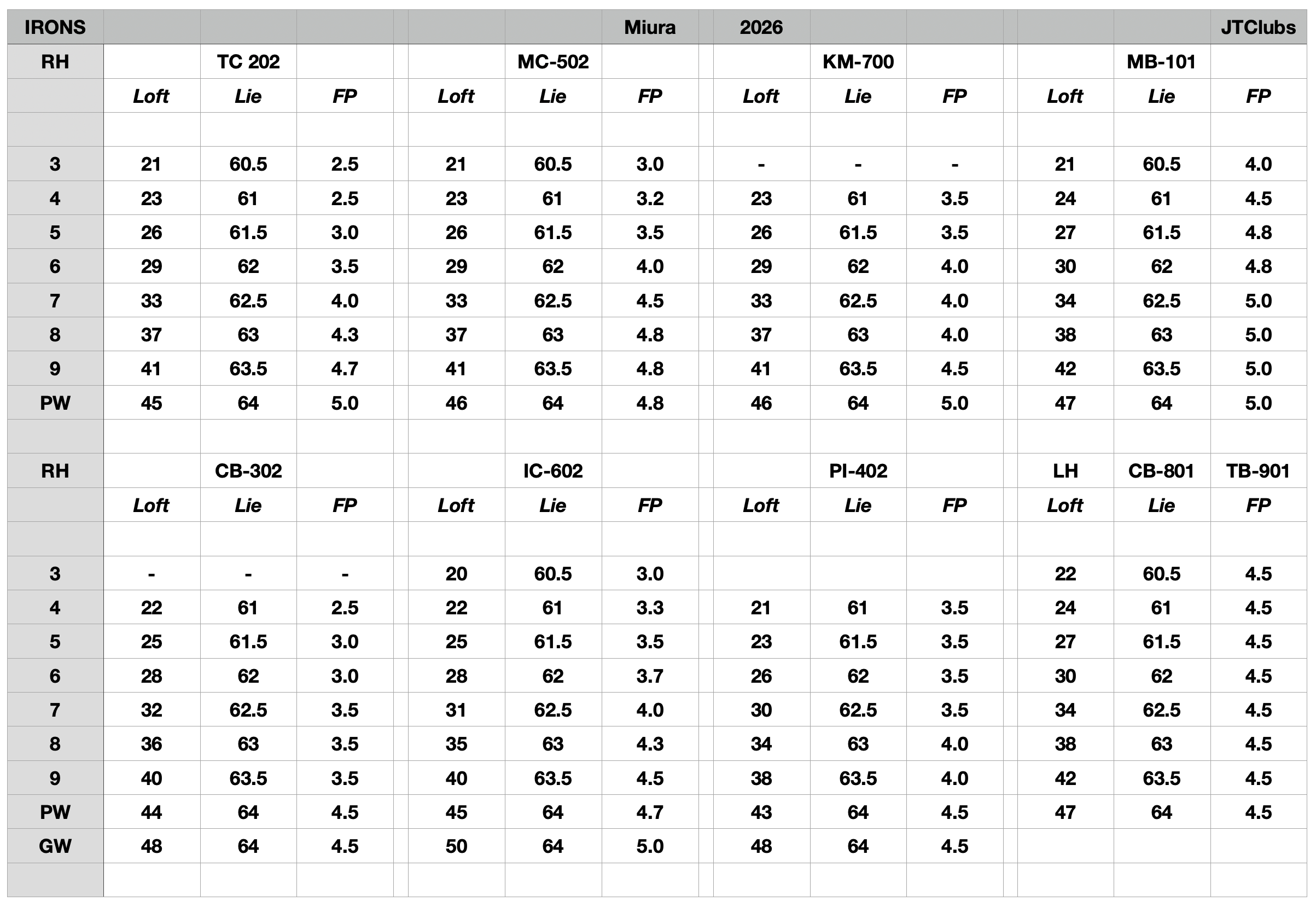
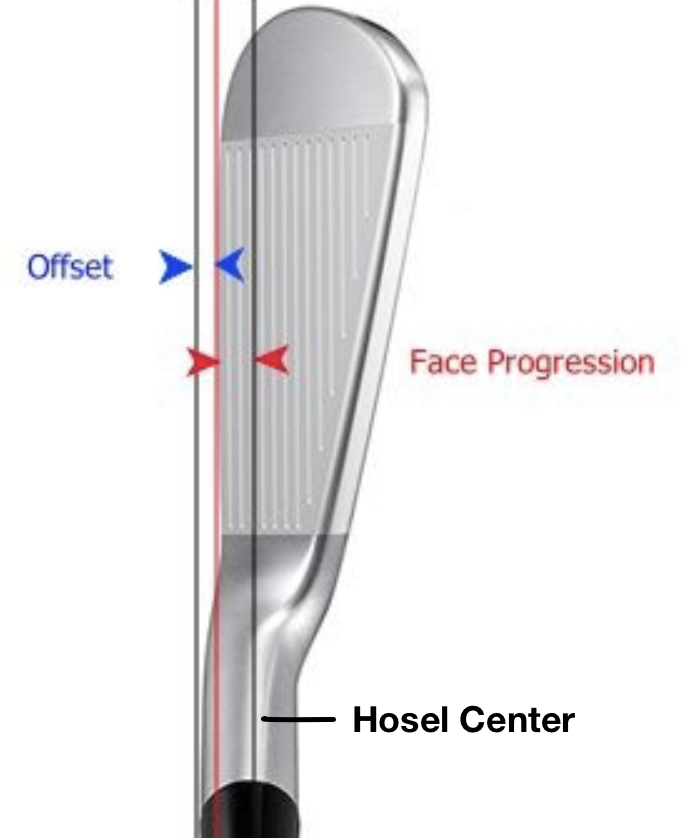
Loft and lie angles are measured in degrees. Face Progression (FP) is the distance from the club’s leading edge to the center of the hosel, measured in mm. Alternatively, measuring distance of the club’s leading edge to the front edge of the hosel is known as offset. Greater FP is equivalent to less offset. Since hosel wall thickness can vary among different models and brands, FP is more accurate in comparing these club design specifications.
The visual effect of greater offset (less FP) is a tendency to close the club face. While increased offset is often marketed as a game improvement feature, it’s visual effect can lead to a negative performance effect for some golfers that might not be overcome by adjusting the lie angle. Testing clubs with different FP/offset options in club fitting is an effective way to find the optimum design for each golfer.
If you play cavity back irons with moderate or more offset and frequently hit an undesired draw not adequately resolved by lie angle adjustments, testing clubs with less offset (greater FP) is recommended. Miura forged blade-related designs merit serious consideration. Every detail has been refined and testing and to achieve a the distinctive feel that draws golfers to play these wonderful clubs.
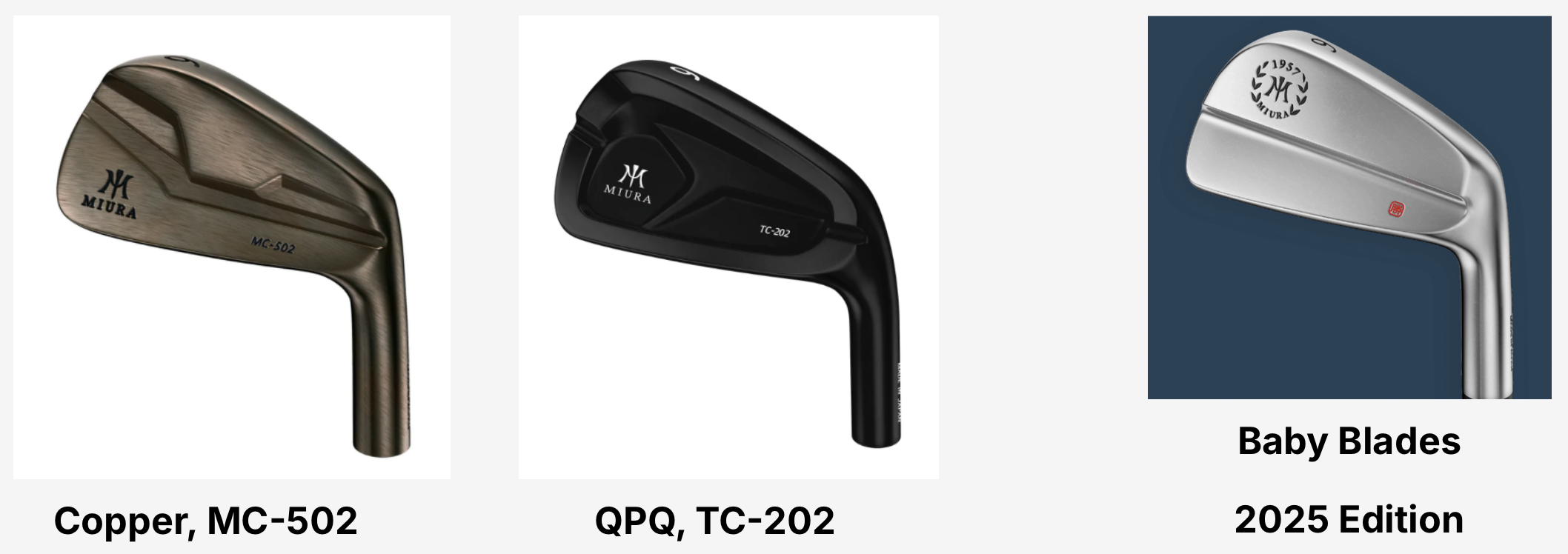
SPECIAL FINISHES, LIMITED EDITIONS. Irons and wedges with special finishes like Copper (develops mellow tone as it ages when exposed to air) are often available in limited production runs. Black QPQ finish or unfinished Raw Carbon Steel are usually available for most clubs.
Limited editions of classic models (like ever popular Baby Blades) as well as signature and commemorative are produced periodically. These clubs typically sell out fast. Let me know if you have an interest in these sets.
Specifications for 2026 Production Miura Wedges
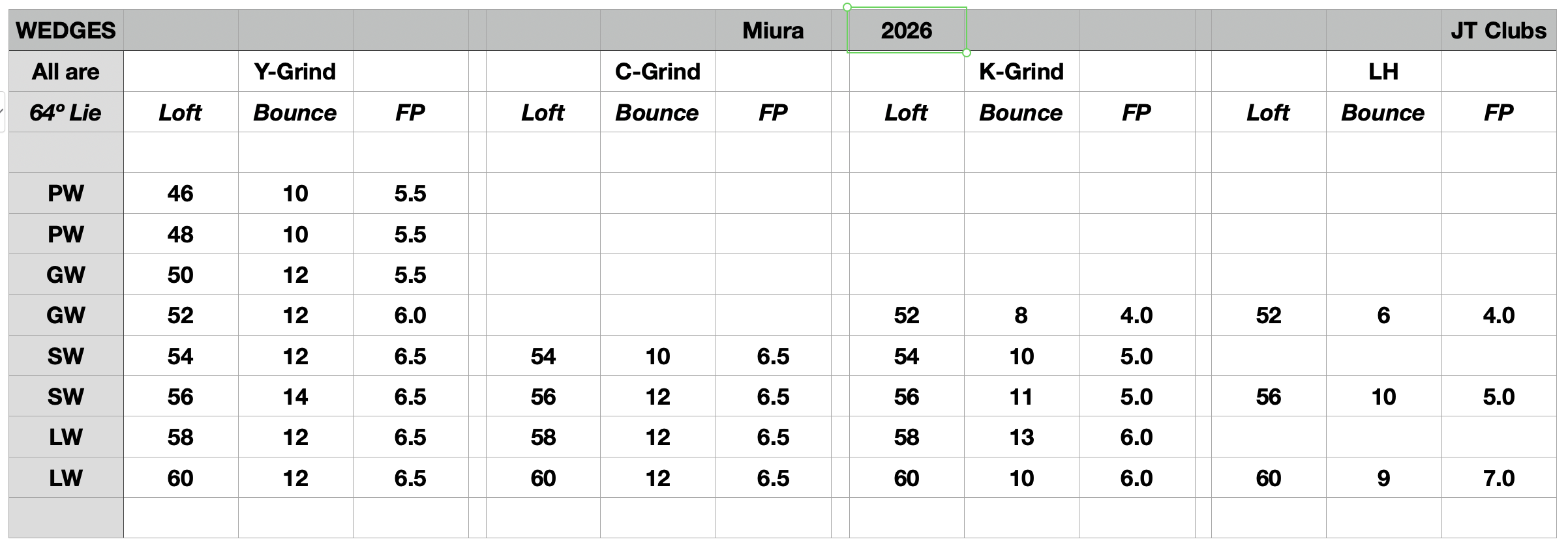
The complementary specifications among these wedge families facilitate assembling an effective set to master the ~25 % of a typical golf score determined by wedge play for golfers at all skill levels. Individual models often have years of development time to refine the versatile features in their design. It means that a new design is released only when it’s ready, and not timed to an arbitrary date.
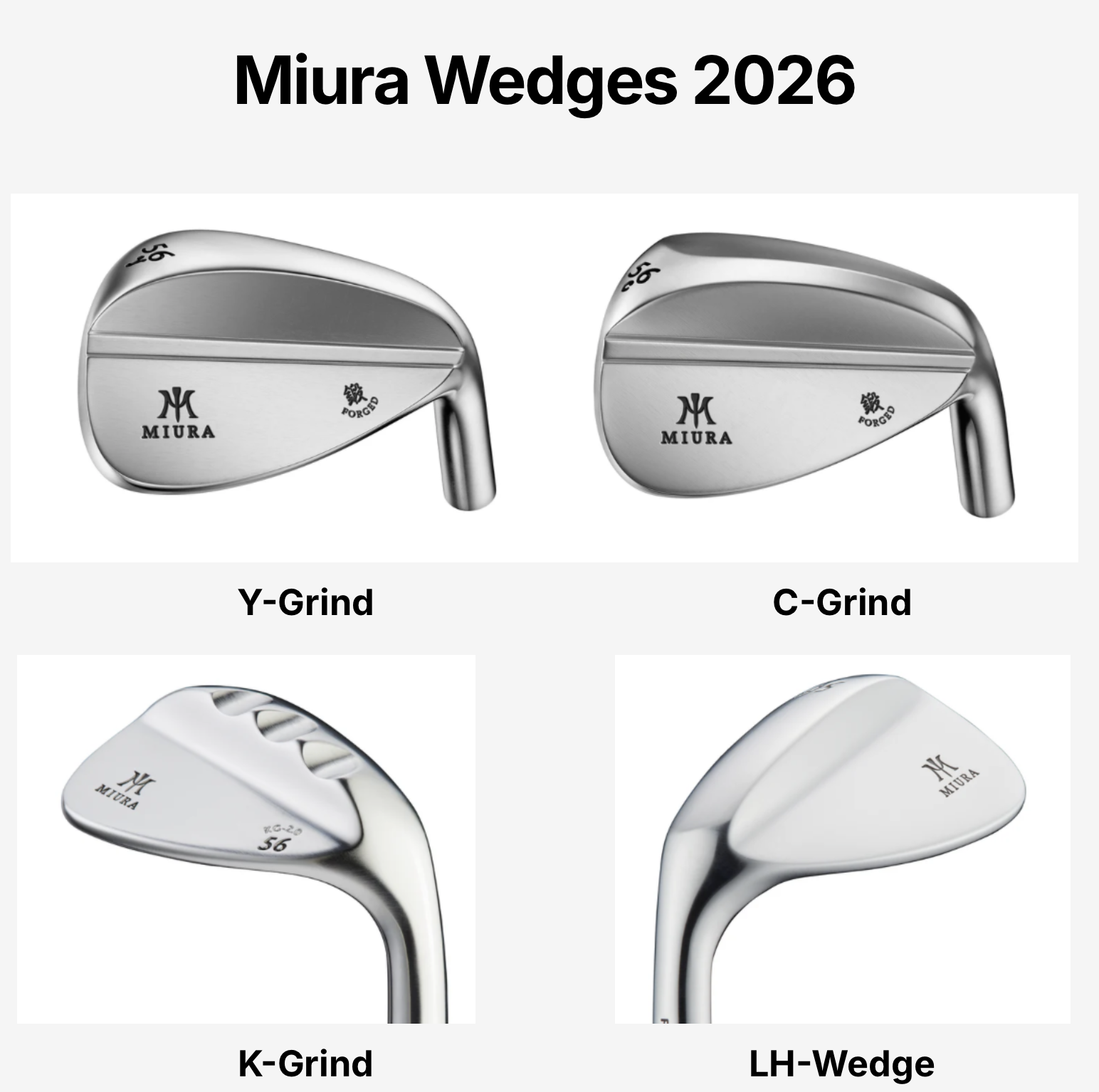
Wedges can be easily combined from different families to assemble your set. The Y-Grind design has a subtle heel and toe roll-off that helps maintain consistent high bounce playability in all conditions. The C-Grind design with more heel and toe sole roll-off facilitates opening the club while minimizing changes to the loft of the leading edge.
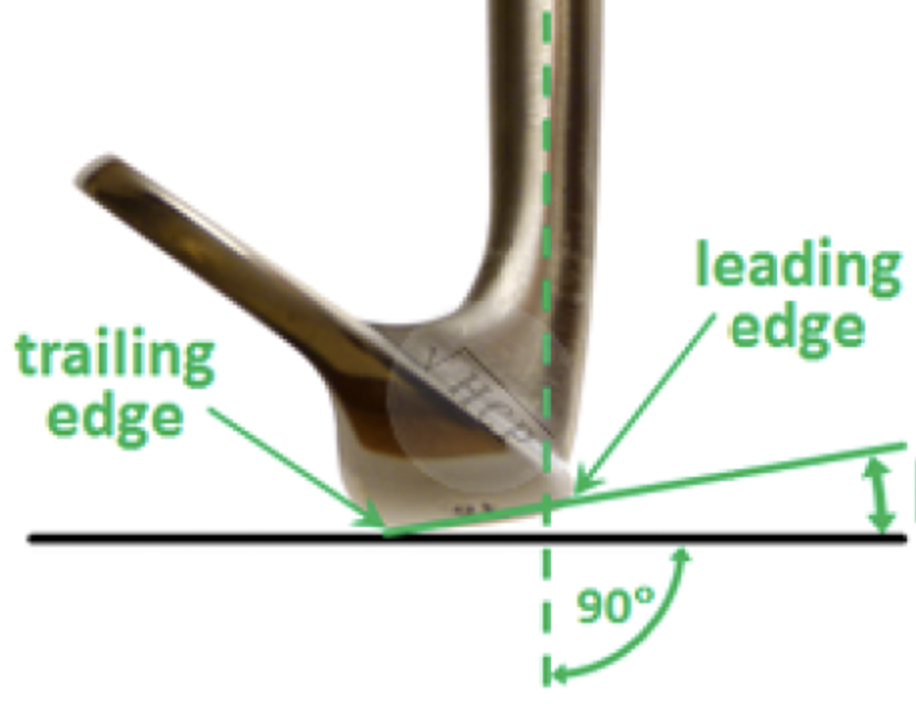
Bounce is the angle formed between the club face leading edge and the lowest point of the sole contacting the playing surface when the club hosel centerline is perpendicular to the surface. Tilting the hosel forward at impact with the ball reduces the effective bounce. Wedge designs with different shapes of sole and leading edge increase shotmaking versatility to match turf conditions. The distinctive feel of Miura forging at the moment of contact with the ball expands performance possibilities not felt with many cast alloys.
Club Fitting, Club Building, and MOI-Matching
A FlightScope X3 advanced radar launch monitor is used to measure how golfers swing each club. Test club heads and shafts have adapters for assembling interchangeable club-heads and shaft combinations for club fitting. Ball trajectory is tracked in a custom-built cage, measured, and analyzed to determine the optimal combination for each golfer.
Shafts are ordered directly from their manufacturer or their verified US distributor. We measure key performance specifications for every shaft to confirm they meet manufacturing specifications and tolerances. Club heads are ordered directly from Miura Golf, and we verify club head weight, loft, and lie angle. We find Miura manufacturing tolerances are the closest in the industry, and enables JTClubs build sets according to your exact fitting results for highest performance.
MOI-MATCHED CLUBS. We recommend building each club in a set to have the same moment-of-inertia (MOI). It’s defined as the resistance to angular acceleration, and it indicates the force required to swing each club. MOI is measured when rotational force is anchored at the club’s butt end. Each club in a MOI-matched set requires the same swing force and has the same swing feel fit to your swing. It leads to greater performance consistency through the set.
In contrast, conventional swing weight matching is not a force measurement. Swing weight is a measure of how weight distribution affects the balance of a club when placed on a fulcrum located 14” away from the butt end of the club. A sliding weight is used to balance the club and generate a reference number, swingweight, that became the target of building matched sets club.
Why is swing weight matching popular? Swing weight balances are inexpensive, widely available, and swing weight numbers are easy to generate. Building clubs to progressive half-inch length differences facilitated swing weight matching to produce club sets that can be bulk produced in a factory to a manufacturing standard. It’s convenient for maintaining set inventories.
Many of the same factors, including club length, are similar in swing weight matched and MOI-matched club-building strategies. However, the arbitrarily fixed fulcrum position used in swing weight matching results in a progressive decrease in MOI as each club’s length decreases in the short irons. Consequently, long irons and short irons in a swing weight matched set will have a more noticeable difference in swing feel that often has a negative effect on playing performance. Sets combining different clubhead designs may help overcome these effects.
BLENDED COMBO SETS. Combining two or three different clubhead designs in one set of irons has become a popular option. The goal is to apply strengths of each design to different length regions of a set. Success with this strategy is enhanced when key design features are complementary, e.g., lie angles, loft progression, face progression, and weight to optimize performance consistency.
Designs that maximize face control are generally preferred for the short irons while long irons benefit from more forgiving designs. Miura designs benefit the assembly of blended sets. The above irons specifications table helps in selecting effective combinations. Models like TC202 for irons #4 - #6 and MC502 for #7 - #PW, for example are complementary.
With MOI-matched sets, replacing a #4 or #5 iron with a more forgiving design like IC602 could be a beneficial transition from a hybrid to a #6 - PW set designed for ball-flight control. At the short end of the set replacing the standard PW with a specialized wedge design may extend short game strategies. When all clubs are MOI-matched performance consistency is preserved while customizing the full bag to individual player preferences.
SHAFT SPECIFICATIONS — WHY WE MEASURE THEM BEFORE BUILDING YOUR SET. Weight and flex variations can affect performance and feel of a golf club. These variations are the result of the manufacturing process, the nature of the materials used, and specification tolerances. Each of these factors merit discussion but our concern is the consistency of the final product.
Total weight and weight distribution are arguably the most important properties affecting shaft playability. Production weight is often used by manufacturers to sort shaft stiffness into different groups, e.g. S and X flex shafts for a particular product. Tolerance ranges for total shaft weight and club head weight can degrade playing consistency through a set.
Unwanted weight variation of shafts and club heads affect feel and playability through a set. Taking time and effort to verify each shaft, clubhead, and grip in building a custom set avoids this problem.